Ted
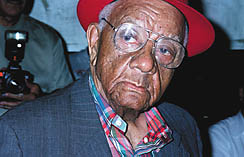
“Double Duty” Radcliffe takes in his 100th birthday party
earlier this month in Chicago.
Photo by Jeff Carlson / Special to The Forum
Tour
of duty: 12 years before Jackie Robinson,
N.D. was home to integrated ball
By Jeff Kolpack
[email protected]
The Forum - 07/28/2002
Chicago
Ted “Double Duty” Radcliffe took two puffs of his cigar as
his face erupted into a huge grin.
He had every reason for the unabashed look of pride and satisfaction.
After all, he was surrounded by people who were helping him begin the
second century of a remarkable life.
It is a life that brought Radcliffe both fame and a place in history,
although for decades his accomplishments were largely unrecognized.
Many of them came nearly 70 years ago during the glory days of baseball
in North Dakota – days when black men weren’t allowed to mingle
with white professional ballplayers in other parts of the country.
Those times seemed so far removed from this recent day of celebration
at Radcliffe’s 100th birthday party in a watering hole just a baseball
throw from Wrigley Field.
In sports talk, the party was a doubleheader sweep:
Radcliffe officially became a centenarian, as party-goers also gave
tribute to Negro League players who died after receiving very little
acclaim during their lifetimes for their skills and achievements on
the baseball diamond.
Double Duty was among the best of them.
No one other than former Major League Baseball Commissioner Fay Vincent
told crowded Slugger’s World Class Sports Restaurant patrons that
Double Duty belongs in the Hall of Fame.
Another grin swept across Double Duty’s face.
A few minutes earlier, party emcee Studs Terkel – the Pulitzer
Prize-winning author from Chicago – presented Double Duty with
a couple of cigars.
“All those doctors say cigars are bad for you,” Terkel said.
“All those doctors have died.”
Double Duty, the oldest living Negro League player, grinned again.
That’s when former Chicago White Sox standout Minnie Minoso led
a chorus of “Happy Birthday.”
North Dakotans once cheered Double Duty as well, but during a far different
time.
“Baseball must have been incredible around here in the hot, dirty
’30s,” said Bruce Berg, a Jamestown resident who wrote a book
about the town’s baseball field. “Old gloves and old wool
suits. It wasn’t pretty but it captured the imagination of the
public.”
The 1935 Bismarck Churchills pitching staff, for instance, is considered
one of the best ever assembled – in any league. It included Satchel
Paige, Barney Morris, Hilton Smith, Chet Brewer and Radcliffe.
Paige, in a 1943 Chicago Daily News article, said the ’35 Bismarck
team was the best he ever saw.
“The best players I ever played with,” Paige said. “But
who ever heard of them?”
North Dakotans and Negro League players knew about them.
“They did have a wonderful staff,” said Ernest Burke, who
made his name with the Baltimore Elite Giants. “They were so darn
good. Just the color of their skin kept them out of the major leagues.
“They were men; so powerful and they kept their heads high.”
Double the fun
Buck O’Neil first met Double Duty in 1935. The two were teammates
with the Churchills, who were named after Bismarck automobile dealer
Neil Churchill.
They traveled to towns like Fargo, Jamestown and Minot.
“And even Dunseith,” O’Neil said. “Everywhere we
went we would fill up the ballparks.”
Bismarck games routinely drew 3,500 people. The Jamestown field was
regularly sold out. The reason was simple: Teams hired great Negro League
talent to give them a short-term lift.
It was the only area of the country where blacks and whites played on
the same team.
Former Negro League players at Double Duty’s 100th birthday party
generally agreed North Dakota was a wonderful host.
“It wasn’t like a lot of people thought it was,” O’Neil
said. “I enjoyed it tremendously. We were treated with a great
deal of respect everywhere we went. It was a place where we were treated
because of our accomplishments.”
Jackie Robinson is given credit for breaking the color barrier when
he signed a minor league contract with the Montreal Royals in 1946.
One year later, Robinson integrated Major League Baseball by joining
the Brooklyn Dodgers.
But Double Duty holds a distinction that will probably be forever forgotten
in baseball history:
He was the first black man to manage an integrated baseball team, as
the player-manager of the 1934 Jamestown Red Sox.
It’s one of many memorable links between Double Duty and his days
with North Dakota baseball.
Negro League players journeyed to North Dakota mainly because they were
offered more money. Owners like Churchill shelled out big bucks to hire
“ringers” during certain periods of the season.
Paige earned $750 a month and Double Duty at least $500 a month. It
was a significant increase from the approximately $125 to $150 most
players made in the Negro Leagues.
Although black players were welcomed in North Dakota for several reasons,
baseball historians like Kyle McNary agree that two stand out:
- Owners like Churchill held so much political clout that they didn’t
stand for public criticism of bringing in black players.
- North Dakota was removed enough from the more populated areas of the
country that residents had no ill feelings toward black players.
Jamestown’s Dick Brown remembers his father, Jack Brown, telling
stories of Negro League players in town. Jack Brown, of whom the Jamestown
baseball field is named after, died in 1999.
“People were more worried about if they could hit or pitch rather
than the color of their skin,” Dick Brown said. “Dad said
he used to let them use something so simple as the showers when in different
parts of the country, that was not a common thing. He said the players
enjoyed coming up here because they were treated so well.”
Double Duty, McNary said, once talked about going a week without a bath.
McNary, who was born in Mitchell, S.D., and lived in Fargo and Bismarck,
wrote the book “Ted ‘Double Duty’ Radcliffe” that
was published in 1994.
Although several obstacles remain, he hopes to start production of a
movie on the Negro League next year at several locations in North Dakota.
The movie has yet to be officially titled.
Double the memories
Ted Radcliffe got his nickname because of his ability as a catcher and
pitcher. In 1932, a sportswriter saw him catch Paige in the first game
of a doubleheader. Radcliffe pitched a shutout in the nightcap.
He regularly played both positions in North Dakota. He won 17 games
while allowing only 17 walks with the 1934 Jamestown team. In 1951,
at age 49, he led the Manitoba-Dakota League in batting while winning
three games on the mound.
He even came out of retirement three years ago to be part of a promotion
by the Northern League’s Schaumburg Flyers. It came against, of
all teams, the Fargo-Moorhead RedHawks. He threw one pitch.
In all, he played for more than 40 teams and had more than 4,000 hits
and 400 homers. On the mound, he had at least 500 wins and 4,000 strikeouts.
He played against Babe Ruth. He played against Fidel Castro in a Cuban
league.
But its has taken many years for the media to give the proper duty to
Double Duty.
Sports Illustrated did a feature on his 100th birthday in the July 15
issue. He was featured by every news outlet in the Chicago area and
nationally by ESPN.
“It’s been hectic,” said Debra Richards, Radcliffe’s
niece. “Right now he’s just tired. He’s still 100 years
old even though he doesn’t act like it.”
One remaining superstar
Those who witnessed the days when Double Duty played all point to the
popularity of the game.
“We didn’t have … no TV, we didn’t have anything,”
said Jamestown’s Harold “Chubby” Schlaht.
Nick Soulis was a Jamestown bat boy in the 1930s when the black players
helped improve the quality of play. He remembers they were the “stars”
while the rest of the team was filled out with amateur-type players.
The crowds, he said, enjoyed more than just baseball. They threw a curve
ball at temperance.
“The favorite drink was a spiked malt,” Soulis said. “I
was too young, but they would buy a malt and dump the booze in there.
Everybody had a good time and the games were good.”
Thankfully, McNary did much of his research while several key ex-Negro
League players were still alive. It’s as if he captured a piece
of Americana just in time.
“Double Duty is the only superstar left,” McNary said.
McNary traveled the Dakotas for the smallest of details. He searched
the archives of several small-town newspapers.
He traced the entire 1935 Bismarck Churchills season to the point of
getting 128 of a possible 130 box scores.
“The best baseball in the world in the 1930s was in Bismarck, Valley
City and Jamestown,” McNary said.
And because of his work, many Negro League players, with Ted “Double
Duty” Radcliffe being the oldest one alive, will find their place
in history.
Readers can reach Forum reporter Jeff Kolpack at (701) 241-5546
What were the Negro Leagues?
The first successful organized Negro League was established on February
13, 1920, at a YMCA in Kansas City, Mo.
The depression years were especially difficult times for black baseball.
In 1932, the East-West League was formed, but folded before the season
ended. The Negro Southern League was the only black professional league
to survive the 1932 season. The NSL was a minor league before and after
the 1932 season.
In 1933, a second Negro National League was formed, and was the only
black professional league operating until 1937. The league included
teams from the East and the Midwest through 1935. By 1936, the NNL was
operating exclusively in the East.
In 1937, teams in the South and the Midwest formed the Negro American
League. The NAL and the NNL coexisted through the 1948 season. In 1949,
the NNL was absorbed in the NAL, which operated as the last black major
league through 1960.
Source: Negro League Baseball Players Association