|
Negro
Leaguer of the Month
January, 2005
Clifford
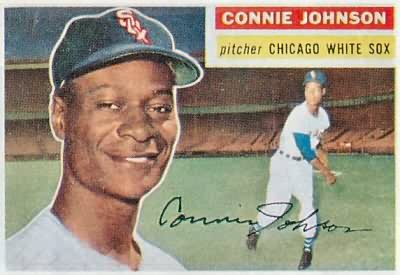
"Connie" Johnson
Born: December 27, 1922 in Stone Mountain, Georgia
Died: November 25, 2004 in Kansas City, MO
Ht:6'-4", Wt: 200
Batted right and threw right
Position: pitcher
Years: 1940-1958
Teams:Toledo Crawfords, Kansas City Monarchs, Colorado Sky
Sox, Chicago White Sox, Baltimore Orioles
Connie
Johnson's story is a fairy tale. No player in Negro League history
rose to stardom faster, and no player had more fun living the
life of a ballplayer than Clifford "Connie" Johnson.
From the age of five, Johnson had only one dream: to travel like
his chauffeur brother and visit four places: New Orleans, New
York, California and Chicago.
In
early 1940, Johnson had never played baseball in his life. He
liked softball, and was very good at it, but wanted nothing to
do with "hardball."
One day, he was in the stands at a friend's sandlot game in Stone
Mountain Georgia, when a player was injured and Johnson was asked
to join the game.
Johnson: "I said, 'No, I can't play no hardball. I had
never caught a hardball. It was hard, that's the only thing I
knew--that it might hurt. They kept asking me so I said, 'Okay,
I'll go in the outfield but I'm not gonna catch no ball. I'll
pick it up and throw it back and try to get the man off, but don't
ask me to catch it 'cause I'm not gonna catch it, I'm telling
you that now!'"
As if written in Hollywood, a ball was hit to Johnson, who made
a fantastic catch and doubled a runner off base. Johnson was an
immediate star and he loved the attention he got from the crowd!
"Oh
man! Now I'm the greatest ballplayer in the world! Girls trying
to catch me and kiss me. Then the team on the other side wanted
me to play with them! I wasn't even thinking about playing ball
but that's how it started."
Later that week, the Toledo Crawfords and Kansas City Monarchs
came to town to play a game and Johnson watched his first Negro
League game. He was awed by the skill of the players, but still
had no intention of playing baseball..
While
the Crawfords were in Stone Mountain, manager Oscar Charleston
and track star Jesse Owens (who had interest in the team) came
to visit Johnson on his family farm (just as Johnson was about
to run away!).
"We
heard you have a good arm and want you to play with us,"
said Charleston.
Despite
Johnson's explanation that he didn't play baseball, Charleston
wanted him to play a game with the Crawfords and Johnson relented.
When they got to the game, Charleston told Johnson he was going
to pitch--against the Kansas City Monarchs!
"I
had a good arm, but I'd never pitched before!" remembered
Johnson. Wearing a jersey that was many times too large for his
skinny frame, Johnson proceeded to throw a great game against
the Monarchs. Charleston asked Johnson to play the rest of the
season and, snap!, Johnson was a Negro League pitcher. As a matter
of fact, with his incredible fastball, Johnson was so good, so
quickly, that he made the East-West All-Star game two months later--the
youngest player ever to appear at age 17!
One night that season, Johnson woke up Oscar Charleston after
he had realized his childhood dream had come true!
"I woke up Oscar at 2 o' clock in the morning. He said, 'what
are you waking me up for?'"
I said, 'Do we go to Chicago?'
'Yeah.'
'Do we go to New York?'
'Yeah.'
'How 'bout New Orleans?'
'Yeah, we go to New Orleans. They got a team, too.'
'What about California?'
'No, we don't go to California.'
I said, 'Shoot. This is what I want.' (Johnson played baseball
in California many times in the Winter Leagues and after joining
the Major Leagues)
Johnson
jumped to the Kansas City Monarchs in the 1940s and joined a staff
with Satchel Paige, John Matchett, Hilton Smith and Lefty LaMarque.
Johnson was probably the hardest thrower on the staff, and in
many towns was mistaken for Satchel himself.
Johnson made his second All-star appearance 10 seasons after his
first, in 1950, allowing 1 run in 3 innings and striking out 3.
Johnson also tripled in two at bats.
When the color barrier was broken, Johnson was signed by the Chicago
White Sox at age 30 and spent parts of five seasons in the Majors.
His best year was 1957 when he went 14-11 with a 3.20 ERA.
In
his years in the Negro Leagues and Majors, Johnson listed Alec
Radcliffe, Harvey Kuenn and Ted Williams as the toughest hitters
he faced (Williams got the first two hits off Johnson in the Majors!)
Johnson
thought that Major Leaguers of the modern day are about as good
as those in his day, but believed they didn't have nearly as much
fun. "I see players now," he remembered. "And they
don't seem like they have fun. We got dressed up and went out
on the town!"
Johnson,
one of my favorite interviews, died last November. I will always
cherish our time together.

This
site, and the webmaster, is powered by Xango™!!!
|