|
Negro
Leaguer of the Month
November, 2004
Ed
"Ace" Stone
Born: August 21, 1910 in Black Cat, Delaware
Died: April 11, 1983 in the Bronx, NY
Ht:6'-0", Wt: 195
Batted both and threw right
Position: outfield
Years: 1931-1950
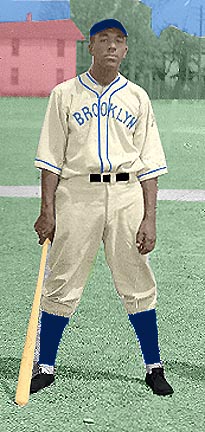
Teams: Wilmington Hornets, Atlantic City Bacharachs, Brooklyn
Eagles, Newark Eagles, Philadelphia Stars, New York Black Yankees,
Pittsburgh Crawfords, Kansas City Monarchs, Nuevo Laredo Owls
(Mexico), Veracruz Red Eagles (Mexico), Torreon Cotton Dealers
(Mexico),Mexico City Red Devils, Havana Lions (Cuba)
Ed wore #3, #28 and #12 with Eagles; #12 and #28 with the Philadelphia
Stars. 
If a
Major Leaguer spent two decades batting in the heart of the lineup
for some of the greatest teams of all-time, you most certainly
would have heard of him. Ed Stone was all these things, save one:
he played with the greatest teams in the Negro Leagues instead.
Add the fact that he had a right-fielder's throwing arm comparable
to Roberto Clemente, and he'd probably be a household name.
Instead,
Ed Stone played with much less fanfare, but with the knowledge
that he would have been a star had his skin color not disqualified
him from the Major Leagues.
Stone
was born in Black Cat, Delaware in 1910 and his first professional
team was the Wilmington (Delaware) Hornets. Almost immediately,
Stone's batting prowess made him a mainstay in the third and cleanup
positions in the batting order. Stone was a prodigious doubles
hitter, and had excellent home run power that was sometimes overshadowed
by the exploits of his teammates.
For
instance, Stone batted third on some of the greatest Newark Eagles
teams ever, where he batted third in front of Mule Suttles, one
of the greatest home run hitters in baseball history. Also in
the Eagles' lineup were Hall of Famers Willie Wells and Monte
Irvin.
Stone
was a five-tool player: power at the plate, ability to hit for
average, great arm, fine glove and excellent running speed.
It
was Stone's arm, however, that may have received the most attention
because, frankly, it was breathtaking. Fans came out early to
watch Stone and his teammates take infield/outfield practice because
Stone made a habit of putting on throwing exhibitions for the
fans.
It's
been reported that Stone could throw a baseball from the centerfield
fence at most ballparks to the plate on a fly (400+ feet). Stone
has to be put in the same class as Martin Dihigo and Sam Bankhead
for outfield throwing arms. With his tall, slender build, Stone
might be compared to today's Major League star Vladimir Guerrero.
Stone,
playing for the Brooklyn Eagles (the Eagles moved to Newark in
'36) made his first East-West All-Star game in 1935, he struck
out as a pinch-hitter, and put on a throwing display before the
game that some Chicagoans are still talking about. Stone was selected
for the All-star game again in '39 and '40, both times representing
the Newark Eagles; he batted .375 in East-West action.
In 1939, Stone's Eagles made the Negro National League playoffs
against a powerful Baltimore Elite Giants team featuring Roy Campanella,
Bill Byrd and Lester Lockett. Baltimore won the series, but Stone
homered in the last two games in a losing effort.
In the 1942 Negro League World Series, the Homestead Grays, after
losing the first two games to the Kansas City Monarchs, "picked
up" Ed Stone, Leon Day, Len Pearson and Lefty McKinnis for
game three. The Grays won, 4-1, but the game was thrown out because
of the "ringers" and the Monarchs won the next two games
to take the series.
Besides starring for the Eagles, Philadelphia Stars and New York
Black Yankees during his career, Stone spent many winters playing
with teams in foreign countries. Stone batted cleanup on a powerful
team in Havana, Cuba, was player-manager for Humacao, Puerto Rico,
and played on a powerful Puebla, Mexico team with Ray Dandridge
and Pullman Porter.
So
how much money did a star of Stone's caliber make? Well, in 1940,
in his prime, Stone made $175 a month. According to his contract
at the time, players could be fined $15 for missing games and
$25 for striking an umpire. Stone never had to worry about those
transgressions.
During
World War II, Stone was chosen to play for Joe Lillards All-star
team in USO camp shows. On the team were Neck Stanley, Thad Christopher,
Showboat Thomas, Dave Barnhill, Harry Williams and Norman Robinson.
After
a great run with the Eagles, Stone was traded to the Philadelphia
Stars for Terris "the Great" McDuffie.
In 1946, Stone was chosen to barnstorm with Jackie Robinson's
All-Stars that played across the country against Bob Feller's
All-stars and prepared Robinson for his 1947 season as the first
modern black Major Leaguer.
After
playing several years with the Philadelphia Stars with legend
Oscar Charleston and All-stars Barney Brown and Bill "Ready"
Cash, Stone closed out his career with a mediocre New York Black
Yankees team.
Stone,
known as a great teammate and modest man, became a chauffeur in
New York after his playing days were over, and rarely talked of
his countless thrills on the baseball field.
I
would like to thank Russell Stone, son of the great Ed Stone,
for providing me with photos and newsclips to help piece this
biography together. Hopefully this bio will be the first step
on the road to Ed Stone receiving the attention he has long deserved
as one of the top Negro League outfielders and clutch hitters
of his day.
Ed
Stone's Mexican League stats, 1940-'50

Ed
Stone's Cuban League stats, 1937-'48


This
site, and the webmaster, is powered by Xango™!!!
|