|
Negro
Leaguer of the Month
December, 2003
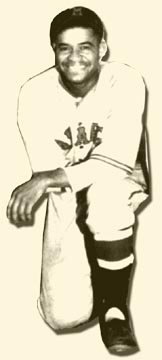
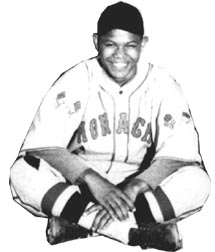
Frank Duncan
Born: February 14, 1901 in Kansas City, MO
Died: Dec. 4, 1973 in Kansas City
Ht:6'-1", Wt: 190
Batted right and threw right.
Position: Catcher
Years: 1919-1948
Teams: Peter's Union Giants, Chicago American Giants, New York
Black Yankees, Homestead Grays, New York Cubans, Palmer House
Stars (Chicago), Kansas City Monarchs
In
the history of Negro League baseball, there were only two catchers
who were so good defensively that teams overlooked the fact that
they barely hit their weight. One was Larry Brown, who has been
chronicled before in the "Negro Leaguer of the Month"
section, and the other is this month's honoree, Frank Duncan.
Duncan
was a big, rough, tough catcher with soft hands and a rifle-like
arm; one of the best defensive catchers ever. He was a perennial
.250 hitter, though, with moderate power. He hit as high as .370
one season, but also as low as .190.
Because
Negro League teams used base-stealing as a weapon much more than
Major Leaguers, a Negro League catcher, first and foremost, had
to be able to stop runners. Duncan had a quick release and could
almost knock down shorstops with his powerful throws.
Duncan,
as tough on the field as he was pleasant off it, could also protect
himself from runners barreling into home, and he was known to
fight if need be. His most famous on-field fight occured in the
1920s when he tangled with the Chicago American Giants' John Hines.
During the fight, a policeman knocked Duncan out cold with a night
stick, and Chicago outfielder Jelly Gardner kicked the unconscious
Duncan in the mouth.
Duncan
was born and died in Kansas City, and, though he played with several
teams in his long career, is associated with the Kansas City Monarchs
for which he played for almost a quarter of a century.
Duncan
started his baseball career in St. Joseph, Missouri's Industrial
League. After a brief stint with Peter's Union Giants, he was
signed by the Monarchs and would play with them almost every year
through the late 1940s. Duncan caught for some of the greatest
pitchers ever, including Satchel Paige, Hilton Smith, Bullet Rogan,
Chet Brewer, Booker McDaniels, Lefty Lamarque, Connie Johnson,
Jack Matchett and Andy Cooper ( he rated Rogan as the best of
them all!.)
In
1922, Duncan and the Monarchs challenged the Kansas City Blues,
from the American Association (the top level of Minor League ball)
to a best-of-nine series. The Monarchs won five of the first six
games to become the "Kansas City Champs."
In
1932, Duncan played a month with the famous Pittsburgh Crawfords,
a team which during the year carried other star catchers Josh
Gibson, Double Duty Radcliffe and Bill Perkins.
Duncan
made his only East-West All-Star game in 1938, going 0 for 1 with
a walk. Duncan was, however, chosen as an All-Star coach for the
West in 1944 and '45, and as the West manager in 1943.
Duncan was named the Monarchs' manager in 1942 and he led them
to a four game sweep of the Homestead Grays in the Negro League
World Series. In 1943, Duncan was drafted into the army at age
42
In
1945, Duncan returned to the Monarchs and managed Jackie Robinson
in his only season in the Negro Leagues. In '46, Duncan was chosen
to play for Satchel Paige's All-Stars during the fall and winter.
Duncan
played several years of winter baseball, but often chose to stay
in Kansas City during the off-season and he took several odd jobs
such as driving a taxi, and driving a bus for the Bennie Moten
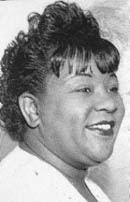
Band. Duncan was a big music fan and married Blues singer Julia
Lee, who, along with her brother George's band, were Bennie Moten's
biggest musical rivals in Kansas City.
After
his playing days were over, Duncan became one of the Negro Leagues'
top umpires.
Duncan's son, Frank Duncan III, was the Monarchs' bat boy in the
1930s and became a Negro League pitcher in the 1940s. When Frank
III pitched to his father, Frank II, they became the first father-son
battery in Negro League history.
|