 |
To
subscribe to a free monthly PitchBlackBaseball.Com newsletter,
just send your email address to: [email protected] |












|
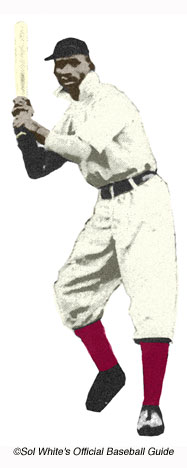
Homerun Johnson
--Grant "Homerun" Johnson, quoted in Sol White's Official Baseball Guide
|
Negro
Leaguer of the Month Grant
"Homerun" Johnson Homerun Johnson was, along with Pete Hill, one of Black baseball's first sluggers. Although he didn't hit home runs as often as the sluggers of today, it must be remembered that the ball used in the late 1800s and early 1900s wasn't built for flight – it was wound less tight, and one ball was sometimes used for an entire game. Johnson was born in Findlay, Ohio in 1874 and began playing shorstop on the sandlots for the Findlay Sluggers in 1894. There are reports that he blasted 60 home runs that season, though most were probably inside-the-park. In 1895 Johnson and Bud Fowler formed the Page Fence Giants with Johnson as captain and shorstop. Over
the next decade, Johnson would play for every one of the powerful early
Black teams, including the Columbia Giants, Cuban X-Giants, Philadelphia
Giants and Brooklyn Royal Giants. Johnson was one of the first Americans to play Cuban baseball, and the first American to win the Cuban League batting title when he batted over .400. In 1910, Johnson was on a team in Cuba that played exhibitions against Major Leaguers. Versus the Detroit Tigers, Johnson batted over .400 and outhit Ty Cobb. Johnson was considered a large shortstop for the era and used a 50 ounce bat. Johnson was one of the early "scientific" hitters in baseball, and studied pitchers like Ted Williams would 50 years later. Like Williams, Johnson didn't like to swing at the first pitch, as he liked to see as many pitches as he could in each at bat. Johnson, unlike Williams, didn't like to swing his hardest, preferring contact over power. With his great strength and heavy bat, Johnson hit homers by accident and not by design. In most years, Johnson's home run totals were around 10. When the great shortstops of Negro League history are mentioned, Johnson is sometimes forgotten, but he was an excellent fielder with a great arm, and he hit in the heart of the lineup for the greatest teams of his era. In 1913, Johnson joined the New York Lincolns and, despite being one of the most popular players of his time, voluntarily moved to second base to make room for rookie John Henry "Pop" Lloyd. Together they formed the greatest doubleplay combination of the time. Johnson didn't hang up his cleats until 1932, two years shy of his 60th birthday.
*Some information compiled from"The Biographical Enclyclopedia of the Negro Baseball Leagues"
|
||