| Negro
Leaguer of the Month
March, 2007
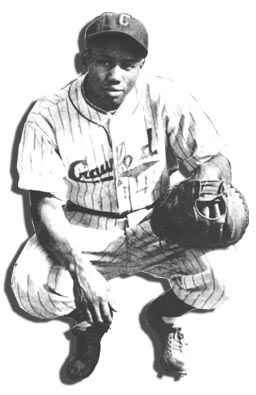
Josh
Gibson
Born: December 21, 1911 in Buena Vista, Georgia
Died: January 20, 1947 in Pittsburgh, PA
Ht:6'1", Wt: 225
Batted right and threw right
Position: catcher, left field
Years: 1929-1946
Teams: Homestead Grays, Pittsburgh Crawfords, Mexico, Dominican
Republic, Cuba, Puerto Rico
Most
Negro League fans have heard that Josh Gibson hit some of the
longest homers in history, but few know that he also hit for
high averages, and was probably the greatest offensive player
in Negro League history.
Gibson
is often called "the Black Babe Ruth," but probably should
be known as "the right-handed Ted Williams." Both Gibson and
Williams hit for average and power, both had superb eyesight,
both used a short stride, both were nearly impossible to strike
out, and both could hit
balls
out
of sight!
Many
stories have been told regarding how Gibson was discovered,
many of them fun but false. The truth is that Gibson played
what would be considered sandlot ball with a youth team called
the Pittsburgh Crawfords (not the Negro League team of the
same name), then was recruited to play with the Homestead Grays
in 1929 when the Grays' regular catcher, Buck Ewing, broke
his finger.
1930
was Gibson's first full season in the Negro Leagues, and, at
age 19, he tore the league apart. With strength that rivaled
Mickey Mantle's, and foot speed just a notch below Mantle's,
Gibson
hit towering homers and could leg out infield hits, especially
since most sane fielders played very deep!
The
'31 Grays are considered by many to be the best team in Negro
League history, and Gibson was the team's top player. It's
estimated that Gibson surpassed 70 homers against all competition,
and probably batted around .450.
In
'32, Gibson, along with other Grays such as Oscar Charleston,
Double Duty Radcliffe and Jud Wilson, jumped to the Pittsburgh
Crawfords, joining Satchel Paige on another incredible team.
Paige and Gibson, the two biggest drawing cards in Negro League
history, helped the Crawfords pack the newly built Greenlee
Field (named after owner Gus Greenlee) in Pittsburgh, and helped
them win a roving "Negro League World Series" title over the
champions of the
South (the Monroe, Louisiana Monarchs), and champions of the
West (Chicago American Giants).
Gibson
stayed with the Craws through '36, then played his last seasons
in the Negro Leagues back with the Homestead Grays where he
teamed with Buck Leonard to form the Negro Leagues' greatest
one-two
punch.
Much has been written about Gibson's catching ability, much of
it unfair. It's true that Gibson wasn't the defensive whiz that Biz Mackey or Larry Brown was, but he was a fine receiver
with the strongest throwing arm in the league. Late in his
career, health problems made catching pop-ups difficult for
Gibson, but on the whole, Gibson was a great all-around catcher.
Fans
had fun watching Gibson play, but not as much fan as Gibson
had playing! It was hard to find people who weren't delighted by his exhibitions on the diamond. With an outgoing personality, and a constant smile,
Gibson relished his career and celebrity greatly.
Gibson
played several seasons in Central and South America,
but nothing ever seemed to change--Josh hit!
In
his career, Gibson batted over .350 against Negro League opponents,
over .370 in Mexico, over .350 in Cuba, over .400 against Major
Leaguers, over .450 in the Dominican Republic, and over. 470
in Puerto Rico!
Gibson
played in 12 East-West games during his career, and, surprise,
he batted .459!
Gibson helped his Grays win back-to-back Negro League World
Series titles in '43 and '44, beating the Birmingham Black
Barons both times. In the '44 series, Gibson batted .400 with
a homer.
Now
to what Gibson was known for: tape-measure homers! Gibson is
one of two players (the other was Mickey Mantle) to hit a ball
completely out of Griffith Stadium in Washington, D.C.; Gibson
hit a homer in Monessen, PA that traveled over 500 in the
air, went out of the park, across a street, and hit the front
door of a house; Gibson hit a line drive off a speaker in center
field at Comiskey
Park
(more
than 450
from
home plate)
that
bounced
back onto the field and was ruled a double--it's estimated
the ball would have traveled 600 feet if not for the speaker;
and Gibson, according to several players, hit the only fair
ball
in history
out of
Yankee Stadium!
Toward
the end of his career, Gibson started having health problems,
and was hospitalized several times. Extremely overweight, his
knees aching, and his spirit broken when Jackie Robinson was
chosen to integrate the Majors (Gibson thought he should have
been the one), Gibson died of a stroke in January of '47, a
few months before Robinson joined the Dodgers.
In
1972, Gibson and Buck Leonard were both inducted into the Hall
of Fame, becoming the second and third Negro Leaguers so honored
(Satchel Paige had been inducted a year before).

XXX
|