| Negro
Leaguer of the Month
June, 2006
Ernest
Judson "Jud" Wilson
Born: February 28, 1894 in Remington, VA
Died: June 24, 1963 in Washington, D.C.
Ht:5'-8", Wt: 200
Batted left and threw right
Position: third base, first base
Years: 1922-1945
Teams:Baltimore Black Sox, Homestead Grays, Pittsburgh Crawfords,
Philadelphia Stars
Satchel
Paige, the greatest pitcher who ever lived, once named the
four hitters who he thought were the toughest ever. In the
Major Leagues, there was Charlie Gehringer, and in the Negro
Leagues there were Josh Gibson, Chino Smith and Jud Wilson.
Smith died very young, and Gibson also died before his time,
but
Wilson gave pitchers--even Satchel--trouble for a quarter century.
Wilson grew up in a poor section of Washington, D.C. called
"Foggy Bottom," and, after a stint in the army during World
War I, started playing professionally in 1922 with the Baltimore
Black Sox.
Wilson
was short and built like a professional wrestler, much like
a Major League star of his era, Hack Wilson. But Jud wasn't
a home run hitter like Hack, he just seemingly hit line drives
whenever he wanted. In fact, his nickname "Boojum" supposedly
came because that was the sound the outfield walls made when
he smashed line drives off them. Wilson was very similar to
Major League star Tony Gwynn, who rarely struck out, and always
seemed to hit the ball hard, regardless of the pitcher he faced.
In his prime, Wilson batted over .400, and had a lifetime average
of about .350. He batted well over .400 versus Major Leaguers
in exhibitions.
Wilson
played for several teams, but is most associated with the 1931
Homestead Grays, the team some
believe
is
the best
in
black
baseball
history.
Besides
being a great hitter, Wilson was also one of a group of Grays
known for their willingness to brawl.
It was said that the Grays "tough guys"--Jud Wilson,
Oscar Charleston, George Britt and George Scales--would fight
at
the drop of a hat, with opponents, umpires and even teammates.
The only Grays player who was completely immune to their roughhouse
tactics was Josh Gibson, who was so strong that no one wanted
to test the young player's fighting prowess.
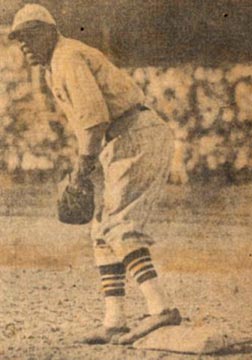
Wilson was a third baseman for most of his career, and was known
to play the position like a goalie; he'd get in front of everything,
let it hit off his chest, then throw the runner out. He wasn't
considered a very smooth fielder, but usually got the job done.
On the '31 Grays, Wilson usually batted cleanup, following Josh
Gibson (Oscar Charleston usually batted leadoff, with Vic Harris
batting second). The Grays won more than 80% of their games during
the season, and whipped a Major League all-star team in a series
in October.
Wilson was voted as a starter in the first three East-West game
(1933-35) and batted .455 in those classics.
Wilson became a manager later in his career and was as hard-driving
as a skipper as he was as a player.
In
2006, Wilson was named to the Hall of Fame, more than 40 years
after his death. Wilson is buried in Arlington National Cemetery.
XXX

This
site, and the webmaster, is powered by Xango™!!!
|