|
Negro
Leaguer of the Month
March, 2003
Sherwood Brewer
Born: Oct. 26, 1899 in Snow Hill, MD
Died: June 15, 1989 in Wilmington, DE
Ht: 5'-11", Wt: 145
Batted and threw right.
Positions: third base
Years: 1918-1937
Teams: Atlantic City Bacharachs, Madison Stars, Hilldale Daisies,
Homestead Grays, Pittsburgh Crawfords.
Inducted into the National Baseball Hall of Fame in 1975.
If you look strictly at batting statistics, you may wonder why
Judy Johnson, with good but not great numbers, is enshrined in
the Hall of Fame. His value to a team, though, belied mere numbers.
First, Johnson was one of the great clutch hitters of his era,
making each hit count. Second, he had one of the game’s great
minds, always studying the game and his opponents to gain every
advantage he could. Third, he played one of the slickest third
bases ever.
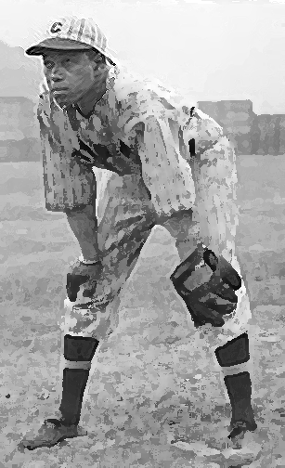
He has been compared defensively to Brooks Robinson and most think
his arm was much stronger. He came in on bunts, caught off balls
in the hole, and stabbed balls down the line. If he had used the
bigger gloves of Robinson’s day, he might never have missed
a grounder!
Johnson grew up in Wilmington, Deleware and played baseball for
his dad’s Royal Blues as a teenager.
Johnson quit high school and worked on the docks in New Jersey
through World War I, before signing with the Madison Wisconsin
Stars, the equivalent of a minor league black team. It was with
the Stars that Johnson picked up the nickname "Judy"
because he resembled teammate Judy Gans.
In 1920, Judy made the black big time when he was discovered and
signed by the Philadelphia Hilldales. For several years, Johnson
teamed with Jake Stevens as black baseball’s best left-side
infield pair.
As a hitter, Johnson was the man teams hated to see at the plate
because he would do anything to get on base. If he couldn’t
hit a certain pitcher, he’d lean into a pitch, take a walk,
anything--a team player all the way.
In his prime, Johnson batted as high as .380 with moderate power
and around 20 stolen bases, but as he got older he became more
of a .280 hitter. He knew his job was to get on base for the big
hitters, and he never tried to do more than that.
Off the field, Johnson is remembered as a sweet person and his
nickname Mr. Sunshine was well-earned.
In the first modern Negro League World Series in 1924, Johnson
led the Hilldale with a .341 average including a game winning
homerun, but the Monarchs won the series five games to four.
In 1925, the same teams met again in the World Series with the
Hilldales winning and becoming the only Eastern Colored League
team to ever win the Championship. Johnson batted only .250, but,
as usual, his few hits were very important.
Johnson was named the East’s best third baseman in 1925 in
a poll taken by the Pittburgh Courier, and the most valuable player
in the East in 1929 by Courier sports editor Rollo Wilson.
After leaving the Hilldales, Johnson spent some of his best seasons
with the Crawfords where he batted well over .300 every year from
1932-1936.
In a 1952 Courier poll, Johnson was named the second best third
baseman in Negro League history, behind only Oliver Marcelle.
After retiring as a player, Johnson became a Major League scout
with several teams including the Milwaukee Braves, for which he
discovered Bill Bruton, his future son-in-law.
Unlike many Negro Leaguers, Johnson was able to enjoy his Hall
of Fame inclusion as he lived for 14 years after his induction
before dying at age 88.
|