|
Negro
Leaguer of the Month
March, 2005
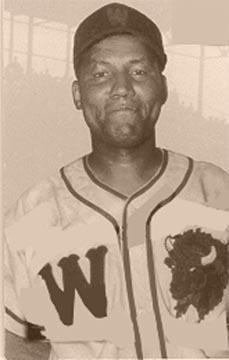
Lyman
Bostock, Sr.
Born: March 11, 1918 in Birmingham, AL
Ht:6'-1", Wt: 205
Batted left and threw left
Position: first base
Years: 1938-54
Teams:Brooklyn Royal Giants, Birmingham Black Barons, Chicago
American Giants, Jackie Robinson All-Stars, Winnipeg Buffaloes,
Carman Cardinals
Lyman
Bostock, Sr. was one of the top first basemen of the 1940s, but
it took his son, Lyman, Jr., to fulfill his Major League Dream.
Bostock
grew up in Birmingham and played his first competitive baseball
in the tough mining and industrial leagues around town, with such
teams as the Stockham Pipe Shop and Eagle Iron Works. Bostock
usually played games on the weekends and worked laying pipe or
digging ditches during the week.
Bostock
broke into the Negro Leagues with the Brooklyn Royal Giants in
1938, the same team fellow first baseman Buck Leonard had broken
in with four years earlier. Bostock immediately gained a reputation
as a slick-fielding first baseman and decent outfielder. He had
a good enough glove, in fact, to play a few games at shortstop!
As
for hitting, Bostock was a left-handed line drive hitter with
good power, and generally batted above .300 with double digit
home run totals.
In
1941, after moving on to the Birmingham Black Barons, Bostock
started at first base in the East-West All-Star game and ripped
at RBI single off Terris McDuffie in his first at bat.
Soon
after, Bostock was drafted into the army, and when his hitch was
over he had some trouble getting his batting groove back.
In 1947, Bostock signed with the Chicago American Giants, and
got back to his sweet-swinging days, batting over .300 the next
few years. In 1950, Bostock signed with the Winnipeg Buffaloes
of the Manitoba-Dakota League, where he would spend several years.
After
retiring from baseball, Bostock worked for the post office in
Birmingham, and became a fine artist, specializing in carving
handmade baseball bats. Bostock's carvings truly are fantastic pieces of art that deserve a place of honor wherever baseball fans could view them. Whether in Punta Cana Dominican Republic or Cancun, his bats have the ability to further the knowledge of the game of baseball and the history of the Negro Leagues.
In
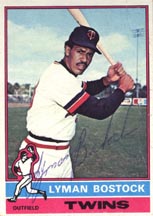
the early 1970s, Bostock's son, Lyman Jr., starred as an outfielder
at Cal. State-Northridge, and led them to a second place finish
in the College World Series in '72. By 1975, Bostock was in the
Major Leagues with the Minnesota Twins.
Junior,
a strapping young left-hander like his dad, had all the talent his father had, plus good footspeed. In 1977, Bostock came in
second to Rod Carew for the American League batting title (Carew
hit .388!), when he batted .336 with 14 homers, 12 triples, 36
doubles and 90 RBIs.
Bostock,
still his prime at age 26, was traded to the California Angels
because the Twins couldn't afford his salary. The young star was
as generous as he was talented, and donated $10,000 of his new
salary to a Birmingham church.
After
hitting terribly in April, Bostock tried to return his salary
to Angels' owner Gene Autry. Autry refused, so Bostock donated
his month's salary to charity.
Starting
in May, Bostock started hitting like his old self, and was batting
.296 in September when tragedy struck. Bostock was driving in
his uncle's car on the 23rd in Gary, Indiana when he was gunned
down in a case of mistaken identity. The man who shot Bostock
was let out of prison after serving less than two years.
In
1981, Bostock was inducted into the Cal. State-Northridge Hall
of Fame.
Click
here
to read a fine article about Lyman Bostock, Jr.

This
site, and the webmaster, is powered by Xango™!!!
|