|
--Mule
Suttles
|
Negro
Leaguer of the Month George
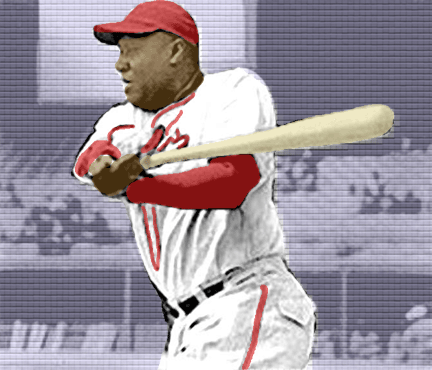
"Mule" Suttles "Just pitch the ball and back up third base!" That was the advice given to some pitchers who found themselves staring at the gigantic Mule Suttles in the batter's box. Suttles, using a 50 ounce bat the size of a wagon tongue, was the Jimmie Foxx of the Negro Leagues--he wasn't as famous as Josh Gibson, just as Foxx was in Babe Ruth's shadow, but his blasts went about as far. Tales abound regarding Suttles, including several 500+ foot homers, a game against the Memphis Red Sox in which he blasted 3 homers in an inning, and a homerun at Havana, Cuba's Tropicana Park that flew over a 60 foot high center field fence and landed in the ocean. Willie
Wells saw the homer and remarked, "He hit this damn ball so
far it looked like we were playing in a lot, it didn't look like no
ball park." Suttles grew up in Louisiana and built his huge muscles working in coal mines. He joined the Birmingham Black Barons in '23 and then moved to the St. Louis Stars who played their home games at Compton Park, which was famous for its close leftfield fence which was lined with tin trolley car barns. Suttles felt at home with the Stars where he racked up dozens of homeruns and he, along with Willie Wells and Cool Papa Bell, led the Stars to the Negro National League pennant in 1928, 1930 and 1931. It was because of Suttle's strength that he got his nickname, and late in games when a big hit was needed his teammates would encourage him with cries of, "Kick, Mule!" Like players as diverse as Reggie Jackson and Mark Lempke, it was when the pressure was the greatest that Mule made his name. In the Negro Leagues' showcase, the East-West All-Star Game, Mule shined brighter than any other star. In the inaugural game in 1933 Mule hit the first East-West homer--the same season the Major Leagues had their first All-Star game and Babe Ruth hit the first homer. It was in the 1935 East-West game, though, that made Mule a household name. The game was tied 4-4 after 9 innings and in the top of the 10th the East scored four times. In the bottom half of the inning the West rallied against Luis Tiant, Sr. and loaded the bases. Hall of Famer Martin Dihigo, who started in centerfield, was called in to relieve and the first batter he faced, Felton Snow, singled in two runs. Alec Radcliffe brought in another, and a Buck Leonard sac fly tied the score and the game went to the 11th. The East didn't score in their half of the 11th and the West opened their half with a Cool Papa Bell single. Then Mule crossed up Dihigo by having pitcher Sug Cornelius go onto the on-deck circle as Josh Gibson batted. Dihigo intentionally walked Gibson only to find out that it was really Suttles who batted next and not Cornelius. Of course
Mule blasted a homer into Comiskey Park's upper deck to win the game.
The crowd exploded and hundreds of hats were tossed onto the field as
Mule rounded the bases. Suttles final seasons were spents playing first base for the Newark Eagle's "Million Dollar Infield" with Ray Dandridge, Willie Wells and Dick Seay. Mule was also considered a fine manager and father figure to many young players on the Newark team. Clarence Isreal was one of those players who loved playing for Mule: "He was considered my dad. Suttles was the most gentle person I ever saw." In 1968 Suttles was diagnosed with cancer and the disease took away his size and strength. When he died he was pencil-thin. Lenny Pearson, who played with and for Suttles recalled in John Holways book Blackball Stars: "He told us, 'When I die, have a little thought for my memory, but don't mourn me too much.'"
|
|||