| |
|
Ray
Dandridge
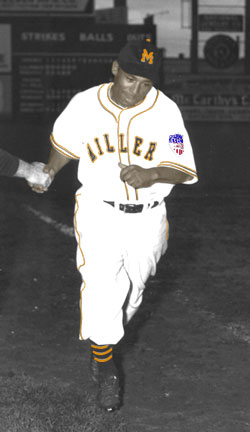
"Dandridge
and [Willie] Wells are two of the finest infielders I’ve ever seen,
bar none. I’ve seen [Red] Rolfe, I’ve seen [Brooks] Robinson,
I’ve seen Graig Nettles, I’ve seen all the great third basemen.
But I’ve never seen anybody who could make the plays any better
than Dandridge."
--Hall
of Fame Major League and Negro League star Monte Irvin
Click here to go to
the
Negro Leaguer of the Month archives
to read about past honorees.

©------------------------------------------------------------------------
Pitch Black™
Movie | Double
Duty Book | Negro Leaguer of the
Month | Gift Shop FAQs
| Art & Poetry | North
Dakota Baseball History | Links
Contact Me | Negro League Message
Board | About the Author | Home
©Copyright 2000-2002, Kyle McNary, McNary Publishing
[email protected]
|
Negro
Leaguer of the Month
August, 2002
Raymond
Emmitt Dandridge
Position:
Third Base
Career: 1933-1954
Teams: Detroit
Stars, Nashville Elite Giants, Newark Dodgers, Newark Eagles, New York
Cubans, Caracus (Venezuela), Veracruz (Mexico), Minneapolis Millers,
Bismarck (Man-Dak).
HT: 5'-7"; WT: 175 lbs
Batted right; threw right
Born: August
31, 1913 in Richmond, VA
Died: February
12, 1994, Palm Bay, Florida
When
you discuss the greatest fielding third basemen in Negro League history,
the short list always includes Judy Johnson, Oliver Marcelle, Bobbie
Robinson and Ray Dandridge. Dandridge may have been the best of them
all with the glove, and was the hardest hitter of the bunch.
Dandridge was seemingly built to play third base. He was short, thick
and bow-legged ("You could drive a truck through his legs, but
not a ground ball," many players agreed), with cat-like reflexes
and a strong, true arm with which he delivered balls overhand, sidearm,
underhand—whichever way got the runner.
Dandridge started his pro career with the Detroit Stars in ’33,
moved to the Nashville Elites Giants, and landed with the Newark Eagles
in ‘36—the team with which he is most associated. The Eagles
fielded the famous "Million Dollar Infield" (their estimated
value, not their salaries!) featuring Dandridge at third, Willie Wells
at shortstop, Dick Seay at second, and Mule Suttles at first.
Despite his odd build, Dandridge was a fleet runner, stole a lot of
bases, and sprayed the ball all over the field—much like Paul Molitor
would 50 years later. He batted over .300 consistently (closer to .350
during his prime) with a handful of homers each season.
Dandridge played in three East-West All-Star games, batting .545, but
missed several of the contests playing abroad.
Dandridge spent much of his prime playing in Mexico. His Veracruz teams
of the early 40s were some of the strongest in history, featuring Josh
Gibson, Wells, Leon Day, Double Duty Radcliffe and Andy "Pullman"
Porter.
Dandridge thrilled Mexican crowds for most of the 40s, setting a hitting
streak record one year, and fielding superbly every year. His play earned
him induction into the Mexican Baseball Hall of Fame.
In 1949 Dandridge was signed by the New York Giants and was assigned
to the Minneapolis Millers, the New York Giants top minor league club.
He won the American Association’s Rookie of the Year award in ’49
with a .363 average at the tender age of 35.
The next year he batted .311 and won the league’s MVP award while
leading the Millers to the pennant. Still, the New York Giants, who
already fielded black players Willie Mays, Monte Irvin and Hank Thompson,
never gave Dandridge the call-up. It was thought that Giants figured
they had their "quota" of black players (Dave Barnhill, another
Negro League veteran signed by the Giants had an 11-3 record on the
mound for Minneapolis and was never called up either).
Dandridge batted .324 in ’51 but probably knew that he would never
make "the show."
Years later, Dandridge confronted the Giants owner and asked why he
was never promoted to the Majors. "Because you were too big a drawing
card in Minneapolis," was the reply.
Dandridge played a season in the Pacific Coast League, and a season
for Bismarck, North Dakota in the Manitoba-Dakota League before calling
it quits in ’54.
For years after retirement it seemed like Dandridge was being denied
another "call-up" he deserved, but in 1987 he was finally
inducted into the National Baseball Hall of Fame in Cooperstown. He
was able to enjoy his membership in baseball’s most elite fraternity
until his death in 1994.
|