|
Negro
Leaguer of the Month
December, 2004
Ross
"Satchel" Davis
Born: July 28, 1918 in Greenville, Mississippi
Ht:6'-2", Wt: 165
Batted right and threw right
Position: pitcher
Years: 1939-1947
Teams:Scullin Steel, Mexico, Baltimore Elite Giants, New York
Black Yankees, Cleveland Buckeyes, Boston Blues
Many
great black players have come out of the sandlots of St. Louis,
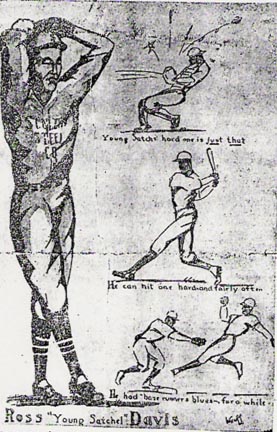
and for a ten-year-period Ross Davis was one of the very best.
Born in Greenville, Mississippi in 1918, Davis' family moved to
St. Louis a few years later and the youngster honed his baseball
skills on the same sandlots that years earlier had produced Cool
Papa Bell and Quincy Trouppe, and later would produce Elston Howard.
Pitching
is what Davis loved and as he grew taller and stronger his fastball's
speed grew exponentially, and he was soon nicknamed for his similarities
to Satchel Paige--both in appearance and fastball speed! He added
a sharp dropping curve and for almost a decade was one of baseball's
hardest pitchers to beat!
In 1939, Davis was one of the top pitchers in the St. Louis MUNY
Industrial League, playing with the Scullin Steel club at beautiful
Tandy Park.
When St. Louis held a semipro version of the East-West Game, Davis
was chosen to pitch for the West. After nervously walking the
first three batters of the game, Davis threw nothing but fastballs
to strike out Luke Easter, Sam Jethroe and Jesse Askew; he would
win the game in impressive fashion. At the game were many Negro
League and Mexican League scouts, and after his performance he
was signed to a $125-a-month Mexican League contract where he
joined the Mexico City squad along with outstanding pitchers Leroy
Matlock and Theolic Smith.
Being a young man with a little money in his pocket, Davis spent
more time painting the town than management liked, and he was
released and sent home.
Back
in American, Davis signed with the Baltimore Elite Giants where
he (20 years old) and Roy Campanella (19) made up the youngest
starting battery in the Negro Leagues. Davis threw a no-hitter
against Max Manning and the Newark Eagles during the year with
Campy behind the plate, possibly the youngest battery for a no-hitter
in pro baseball history! In the no-hitter, Davis also singled
and doubled at the plate!
After a short stint with the New York Black Yankees, Davis left
the Negro Leagues and returned homewhere he played in the industrial
league again at Tandy Park.
After
a few seasons of semipro ball, Davis returned to the Negro Leagues
with the Cleveland Buckeyes, and it was with the Buckeyes in 1943
that Davis had his biggest thrill. In a game versus the Memphis
Red Sox, Davis pitched in front of his hometown fans, family and
former semipro teammates. He won, 2-1. For the season, Davis won
19 and lost 2. Another thrill came later in the year when he faced
the original Satchel and beat him 6-5 in Rochester, NY.
Davis went into the army soon after and it was in the service
that he contracted hepatitis and was told he should stop playing
baseball for good.
In
1946, the United States League, the brainchild of Branch Rickey
with the main goal of scouting Negro Leaguers, was formed and
the Boston Blues came calling for Davis. The Blues' owner, Alan
Johnson, was one of the richest black men in the country, and
he made Davis an offer he couldn't refuse and despite warnings
from his doctors, "Satchel" un-retired to the tune of
$600 a month, usually paid out of a suitcase stuffed with cash.
Davis had many outstanding games for the Blues, including a win
over Oscar Charleston's Brooklyn Brown Dodgers in which he k'd
10, and a 9-3 win over the new version of the Pittsburgh Crawfords.
The
Blues were managed by Tom Parker, and boasted stars Elridge Mayweather,
Hiram Marshall (3B), Bradford Bennett (OF), Slats Newkirk (P)
and Leroy Sutton (P).
In
1947, with his arm worn out after pitching a majority of the Blues'
big game, Davis had decided to retire. During spring training,
Davis visited the Buckeyes at Cleveland's League Park just to
catch up with his old teammates. By the time he left the field,
he had been convinced to help coach some of the pitchers. By the
end of spring training, Davis had convinced himself that he still
had something left and he started the team's first game of the
season, striking out seven batters in three innings. After the
season was over, in which he proved he stil had a lot of baseball
left, Davis retired for good at the age of 29!
"It just became a job," explained Davis, "instead
of a game."
Davis gave up only one homerun during his career, to Josh Gibson,
but considered Buck Leonard a superior batter to the more famous
Gibson. "I could get Gibson out. If you threw the ball just
above his chin, you could strike him out, but if you missed he
would kill the ball," explained Davis. "Buck had no
weakness. He was terrible! And Jerry Benjamin, another Gray player,
whipped me all the time!"
Besides
Satchel Paige, Davis was most impressed by Hilton Smith, who he
considered to have an amazing curveball.
After
baseball, Davis worked various jobs and retired for good in 1995.
He still enjoys talking baseball, especially to children.
I greatly enjoyed interviewing this wonderful man, and want to
thank a big fan of Mr. Davis named Miranda for setting up the
interview.

This
site, and the webmaster, is powered by Xango™!!!
|