|
Negro
Leaguer of the Month
April, 2003
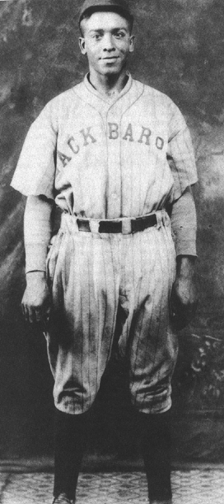
Saul "Rareback" Davis
Born: February 22, 1901 in Bayou, Louisiana
Died: in Minot, ND
Ht: 5'-10", Wt: 165
Batted and threw right.
Positions: shortstop, second base, third base, manager
Years: 1917-1952
Teams: Vapor City Tigers, Columbus Buckeyes, Birmingham
Black Barons, Memphis Red Sox, Chicago American Giants, Colored
House of David, Gilkerson’s Union Giants, Zulu Grass Skirts
I met Saul about two years before he died at age 92. He lived
in Minot, North Dakota of all places, and he was the last surviving
member of the original Eastern Colored League.
Saul was also one of the last surviving members of the “Original
Negro National League.” (In 1920 the Negro National League
was formed of teams in the Midwest and South, in 1923 the Eastern
Colored League was formed of teams on the coast. Both leagues
broke up during the depression and when two major black leagues
were reformed in the late 1930s, Midwest and southern teams formed
the new Negro American League and the eastern teams formed the
new Negro National League.) Saul didn’t like when people
said they played in the Negro National League if it wasn’t
the original.
I was fortunate to have formed a friendship with Saul a few years
before his death and he was a very friendly and interesting man.
Saul was born in 1901 in Louisiana territory and after a playing
on the sandlots of Bayou country, he traveled to Arkansas where
he joined the Vapor City Tigers of the Arkansas Negro League consisting
of Hot Springs, Hope, Arkadelphia, McGee and El Dorado.
Saul was a slap hitter, which was common in the early days before
Babe Ruth made the homerun popular, but was known more for his
slick glove and strong arm.
In the days before Derek Jeter, A-Rod and Cal Ripken, shortstops
were meant to field well, and if they hit it was a bonus. Well,
Saul could play shortstop, but he usually struggled to bat .250
most of his career.
Saul used a “Bottle Bat” the model made famous by Major
Leaguer Heinie Groh.
Saul would rarely strike out, but would try to punch the ball
over the infield. He only hit a handful of homers in his long
career.
"Was
[baseball] better back then? Oh sure, we had better ball players.
You see, the ball players now got so much protection. Ball players
today can’t even get out of the way of a fastball. You know
what I mean? Well, they get hit by it then they want to fight.
Well ,that’s no good.
"But see, we had to dodge them fast pitchers. We couldn’t
stand up there and dig a hole, wait ‘til somebody throw you
a ball you could hit and blow your bubblegum, eat your peanuts
and stuff like that. See we couldn’t have that. You bring
that in the dugout and you went on!"
After honing his skills in the Arkansas Negro League and the Texas
Negro League, Davis made the black Big Leagues as a starter with
the Birmingham Black Barons in the early 1920s. Davis was a huge
fan of Rube Foster and always wanted to play for his Chicago American
Giants. He got his wish in 1925 and remembered his years in Chicago
as some of his happiest.
In the late 1920s, Davis joined the Gilkerson’s Union Giants,
as top black traveling club, which also featured stars George
Giles, Cristobel Torriente, Red Haley and Hurley McNair.
When Davis’ skills began to deteriorate in the 1930s he would
travel around Canada with his baseball gear and a uniform in his
car trunk, showing up at tournaments and asking teams if they
needed any players. He played against Chicago “Black Sox”
players Hap Felsch and Swede Risberg and their Virden, Manitoba
team several times.
One thing Davis refused to do, though, was play against Satchel
Paige, Double Duty Radcliffe and “that whole crew.”
“’Cause you can’t do no good,” explained Davis.
“ I was trying to make a reputation. I could beat the average
players in these white clubs. But when you get with these Negroes
you got to be careful, you know. They gonna try to show you up.
Some players called in sick when they had to face Satchel and
them. That’s it. You got to do that.”
Davis
got to meet Britain's Queen Elizabeth on her trip to Canada while
playing in a tournament at Portage La Prairie, Manitoba, Canada.
In the late 1930s, legendary second baseman Bingo DeMoss and Abe
Saperstein asked Davis to become player manager of the “Zulu
Grass Skirt Team,” a traveling team that would wear grass
skirts and make up to appear like savages from an African Tribe.
Although it seems degrading now, Davis enjoyed the experience
as the team traveled with Jesse Owens who would take on the fastest
runners teams could come up with and then blow them away. The
team also drew great crowds throughout the Midwest and Canada.
After the team broke up in North Dakota in the 1940s, Davis settled
in Minot, North Dakota and stayed there until the day he died.
It’s rumored that Davis made a nice living by running a club
in Minot for years that was really a “house of ill-repute”.
One thing that Davis was especially proud of was the friendships
he made in baseball and kept. Satchel Paige made several trips
to visit Davis in Minot over the years, and he corresponded with
other players by mail for decades.
|