|
Negro
Leaguer of the Month
April, 2005
George
"Walter" Ball
Born: September 13, 1877 in Detroit
Died: December 15, 1946 in Chicago.
Ht:5'-10", Wt: 170
Batted left and threw left
Position: pitcher
Years: 1899-1923
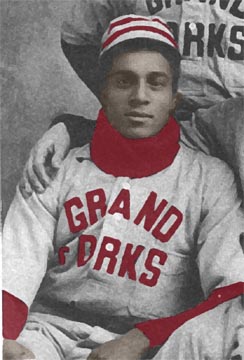
Teams: St. Paul (MN), St. Cloud (MN), Grand Forks, (ND), Augusta
(GA), Chicago Union Giants, Cuban X-Giants, Philadelphia Giants,
Brooklyn Royal Giants, Chicago Lelands, Quaker Giants, St. Paul
Colored Gophers, Pittsburgh Keystones, Chicago Giants, Chicago
American Giants, St. Louis Giants, Mohawk Giants of Schenectady,
NY, New York Lincolns, Milwaukee Giants, Cuba.
Walter
Ball was one of black baseball's very first great pitchers, combining
pinpoint control with the occasional spitter to make up for a
lack of overwhelming speed.
Ball
was born in Detroit, Michigan, but grew up in St. Paul, Minnesota,
and spent a decade playing for predominantly white teams.
According to Jim Karn in "Swinging for
the Fences," Ball's first pitching decision published
in a paper was a victory against a team called the Tigers in 1896
by the score of 26-25.
Ball plied his trade on the sandlots of the Capital City with
the "Young Cyclones," a top amateur team. In 1900, Ball
became a professional when he signed with the Grand Forks semipro
team. Ball often pitched in games in which "purses"
of less than $20 were offered to the winner.
In
1902, Ball returned to Minnesota and pitched St. Cloud to a semipro
championship.
Over
the next several years, Ball played for many teams in the Midwest.
During that era, most teams carried only a couple pitchers, so
Ball was expected to pitch often, and rarely was given the luxury
of a relief pitcher if he got into trouble. Ball usually won more
than 20 games a season, struck out more than a batter an inning,
and had an ERA of less than two runs.
Ball
was known as a classy man and sharp dresser, and was usually treated
well, to his face, in the smaller towns in which he played in
his early career. However, many Midwest towns, despite loving
the way Ball pitched, didn't like having a black man representing
their town, and Ball was released several times after great seasons
on the field.
Ball, besides being a first-class pitcher, was industrious. While
pitching in North Dakota, Ball picked up extra money as a train
porter and while pitching for St. Cloud (MN), Ball rented cushions
to fans at the ball park at a nickel a piece.
In
1903, Ball jumped to the big time in black baseball, signing with
the Chicago Union Giants, the first all-black team he had played
for, and in 1904, Ball jumped to the Cuban X-Giants, and beat
the Brooklyn Dodgers during the year, his first victory over a
Big League club. His teammates on the X-Giants included Homerun
Johnson and Dan McClellan.
After
a few more years in Midwest black baseball, Ball returned to St.
Paul to start the St. Paul Colored Gophers.
Continuing
his nomadic days, Ball eventually returned to Chicago again and
pitched with the Chicago Giants and Chicago American Giants, teaming
with such stars as Rube Foster, John Beckwith and Steel Arm Taylor.
By the time the first Negro National League was formed in 1920,
Ball was nearing the end of his career, though he reportedly pitched
a few more seasons.
Ball
continued to stay in baseball after his playing days were over,
coaching, organizing, etc., and at the 1937 East-West All-Star
Game in Chicago, Ball was honored on the field.
Ball
died in December of '46, but not before Jackie Robinson had played
an incredible season with the Montreal Royals. Ball, as well as
the rest of the baseball world, knew that the color line in the
Majors was on its last legs.
Ball,
a certain Major League star pitcher had he been born 40 years
later, is buried in Lincoln Cemetery (Cook County, IL), about
60 feet, six inches from Rube Foster's grave.

This
site, and the webmaster, is powered by Xango™!!!
|